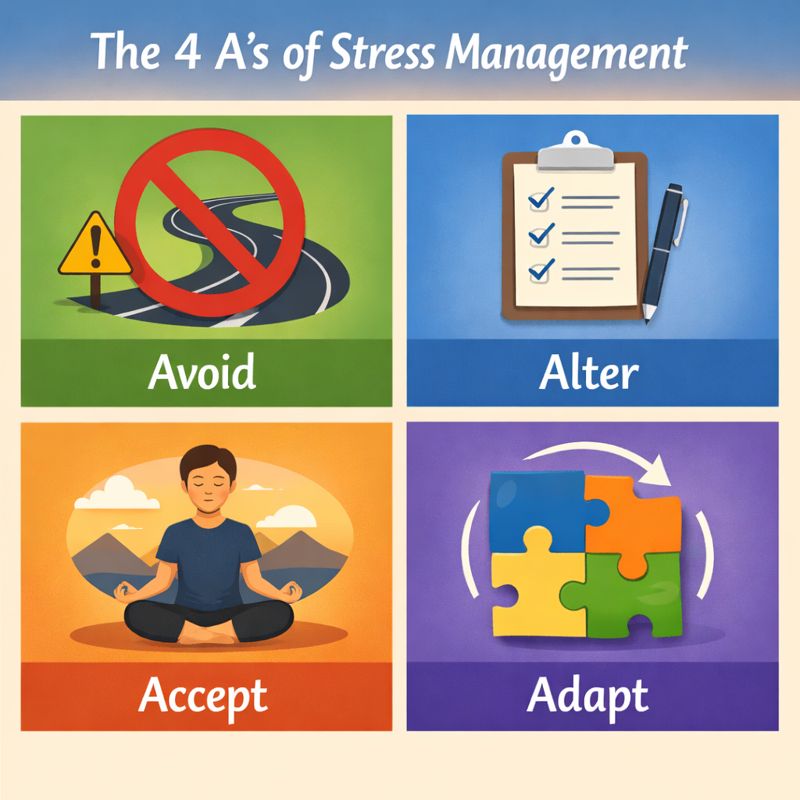
The 4 A’s of Stress Management: Avoid, Alter, Accept, Adapt
By John Gendron — 01/06/2026 — Building Personal Resilience
Click play for audio.
Stress is inevitable — but how you respond to it determines the impact it has on your life. Many people go through their day reactively, letting stress take the lead. But with awareness and intentional practice, you can reclaim control.
In my coaching practice, I use a wide range of evidence-informed skills tailored to each client. While acronyms and step-by-step models are popular online, true coaching is never one-size-fits-all. Still, some models can be helpful starting points for self-reflection. One of these is the idea of avoiding, altering, accepting, or adapting to a stressor.
In this article, we break down each of the “Four A’s” with real-world examples and practical strategies you can start using today.
Avoid
You can’t avoid every stressor. You can avoid many that drain your energy unnecessarily.
- Say no to commitments that don’t align with your priorities.
- Step back from toxic or confrontational relationships.
- Limit exposure to topics or environments that consistently rile you up.
- Protect your personal space when possible; your home, your television, even your car can become a small “reset zone.”
Avoidance isn’t running away; it’s conserving energy for what truly matters.
Alter
To alter a stressor, you intentionally change the situation or your response to it.
- Communicate assertively, expressing needs, expectations, and boundaries respectfully.
- Identify patterns: Has this stressor happened before? If so, why?
- Problem-solve proactively to prevent repeat situations.
Small changes often create meaningful relief.
Accept
Some stressors cannot be changed or avoided such as loss, illness, natural disasters, and other uncontrollable life circumstances. Acceptance is not approval; it is acknowledging reality so you can move forward.
- Focus on what you can control.
- Ask for support.
- Notice areas where challenges bring new perspective or opportunity.
- Share your feelings; pressure builds when emotions stay bottled up.
Acceptance brings steadiness to situations that cannot be fixed.
Adapt
When you can’t change the stressor, you can change the meaning you give it.
As I wrote in my second article, “Understanding Stress – The Science Behind How Your Body Responds,” stress is not determined by what happens to us, but by how we interpret the event.
Adapting may include:
• Reframing problems
• Adjusting rigid standards (“good enough is good enough”)
• Focusing on the big picture
• Practicing flexibility
• Strengthening relaxation skills so your nervous system has an automatic “off switch”
It is a well-established fact in stress physiology that the body cannot be stressed and relaxed at the same time. Practicing the relaxation response helps you shift into calm more quickly. (See relaxation classes.)
Practical Examples
In all four strategies, avoid, alter, accept, adapt, the real work is internal. The story in your mind determines the amount of stress you feel.
Driving example:
A driver cuts you off on the highway. You cannot change the driver, but you can change your interpretation. I’ve trained myself to say, “Well, he must have left his house this morning determined to find me and cut me off.” The absurdity makes me laugh and resets my stress response.
At work:
Increasing demands and new rules can create tension. Remember, your supervisor is often under pressure as well. Shifting from an “individual struggle” mindset to a team-based, solution-focused approach often leads to better communication and a healthier work environment.
Caregiving:
If you are caring for loved ones, pause and breathe. Your clear thinking is essential for their safety and well-being.
- Prioritize what matters most.
- Delegate when possible.
- Turn chores into simple games or collaborative tasks with children.
- Build micro-breaks into your day.
- Recognize that what you’re doing is heroic.
Relationships:
Many loving couples struggle because of how something is said, not what is said. Small communication adjustments such as mirroring your partner’s communication style (“I hear you” vs. “I see what you mean”) can reduce misunderstandings. Even small changes can interrupt heated patterns.
Three Quick Exercises You Can Start Today
While you can’t remove all stressors from life, you can strengthen your ability to handle them.
- Learn relaxation skills.
(I teach these and they work.) - Identify your personal stress patterns; notice which situations repeatedly trigger you.
- Plan your ideal response: Avoid, Alter, Accept, or Adapt.
These skills take reflection and practice, but they can fundamentally reshape how you experience stress.
A Personal Note
Some people think that by sharing tips and strategies, I’m “giving away the store.” I see it very differently.
I respect anyone who has the initiative to learn, practice, and apply these skills on their own. That kind of determination is rare and admirable.
But stress is complex, and most people benefit from the guidance, accountability, and support that professional coaching provides. A qualified coach helps you navigate long-standing patterns, stay committed, and move steadily toward healthier, more sustainable habits.
If you’re ready to move forward, I’m here to help.
To Get Started ...
Before I can help you, we need to determine what your needs are. This starts with a free stress assessment and a free consultation. You can also get free stress tips, stress quotes and previews of upcoming blogs. Just contact me by clicking one of the buttons below to make your request.
(For more about John, visit About/John. For services, see Services.)
Services by Appointment Only
Please see Read-Me for Company Policies.
Mind Body Bridge, LLC
Winterbrook Drive
Cranberry Township, PA 16066
