Understanding Stress: The Science Behind How Your Body Responds
By John Gendron — 01/05/2026 — Fundamental
Click play for audio.
You’ve heard people say “I’m stressed” hundreds of times. But what does that actually mean? When your heart jumps, your stomach tightens, or your thoughts start to race, you’re experiencing more than frustration — you’re tapping into a biological safety system that’s millions of years old.
Understanding how stress really works doesn’t just satisfy curiosity. It gives you power. Whether you’re a caregiver, a professional, or someone who feels pulled in too many directions, knowing why your body reacts the way it does can help you work with your system instead of feeling carried away by it.
What We Really Mean When We Say “Stress”
People often think stress comes from events — deadlines, conflicts, finances, or difficult conversations. But stress isn’t what happens to you. Stress is how you interpret what happens.
A simple working definition:
Stress is a perceived need for change.
A stressor that overwhelms one person may barely register for someone else. What matters is not the event, but whether your brain labels it as a threat, challenge, or demand.
This distinction is important, because it means stress is not a sign of weakness or failure. It’s a signal.
Where It All Began: The Evolutionary Roots of Stress
Stress is often described as the fight-or-flight response. Humans evolved as hunter–gatherers where real danger—predators, injury, starvation—was part of daily life.
If you encountered a bear, you had three choices:
- Freeze (to avoid detection)
- Fight
- Flee
The moment you sensed danger, your body shifted into high gear:
- Heart rate and breathing increased
- Blood pressure rose
- Muscles tensed
- Pupils widened
- Non-essential systems (digestion, immunity, reproduction) temporarily slowed
- Your senses sharpened
This rapid shift was controlled by your sympathetic nervous system — your internal accelerator pedal.
When the danger passed, the parasympathetic nervous system (your brake pedal) returned everything to normal. This is homeostasis — the body’s natural balance.
This system kept our ancestors alive. And it’s the same system we still use today.
The Stress Pathway: A Simple Look at a Complex System
The stress response happens in two main waves.
Wave 1: The Fast Response
Almost instantly, upon sensing a threat, your body releases:
- Epinephrine (adrenaline)
- Norepinephrine
This creates immediate physical changes — boosted energy, sharper senses, faster breathing — preparing you to act right now.
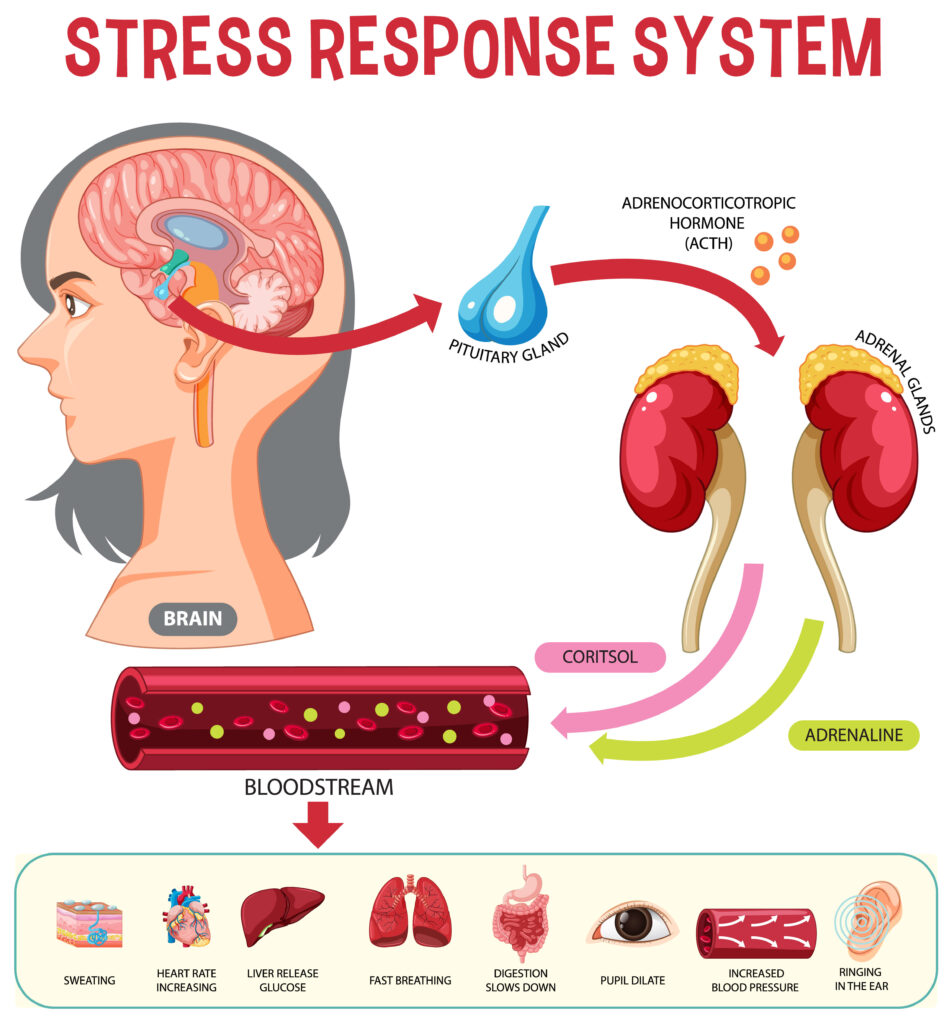
Wave 2: The Sustained Response — The HPA Axis
If the stress doesn’t pass quickly, another system activates:
the HPA axis (hypothalamic–pituitary–adrenal axis).
Here’s the simple version:
- Hypothalamus releases CRF (corticotropin releasing factor)
- Pituitary gland releases ACTH
- Adrenal cortex releases cortisol
Cortisol is your stamina hormone — it keeps energy available for a longer-term challenge.
When the stressor ends, your brain senses rising cortisol levels and sends a “stop” signal to turn the system off. Everything returns to normal… if the system has time to reset.
Why Modern Life Overwhelms an Ancient System
This is where things get complicated.
Our bodies evolved to handle occasional threats — a predator, an injury, a storm.
But modern life delivers hundreds of small stressors every day:
- Work pressure
- Finances
- Caring for others
- Traffic
- Emails
- Conflict
- Social comparison
- Information overload
- Constant notifications
None of these are life-threatening, but your brain often treats them as if they are.
Worse, they happen back-to-back, with little recovery time.
The result?
Chronic Stress.
Your body was designed for sprints, not marathons.
Biology cannot distinguish between:
- A bear charging at you, and
- A demanding boss or upsetting text message
The same systems activate — over and over — long past their intended use.
This isn’t because you’re broken.
It’s because you’re mismatched — an ancient survival system in a modern environment.
How Your Brain Interprets Stress
The brain plays the deciding role in whether something feels stressful.
- The Amygdala — Your Smoke Alarm
- Fast
- Emotional
- Reacts before conscious thought
- Doesn’t distinguish “real” danger from imagined danger
This keeps you alive, but it also keeps you jumpy when overloaded.
- The Prefrontal Cortex — Your Voice of Reason
- Logical thinking
- Perspective
- Problem-solving
- Emotional regulation
But here’s the problem:
High cortisol shuts this part of the brain off.
That’s why stressed people:
- Overreact
- Forget things
- Lose focus
- Make impulsive decisions
It’s biology, not character.
- The Limbic System — Emotion, Memory, and Meaning
Past experiences live here.
Old wounds can make small stressors feel enormous.
- The Perception Loop
Your thoughts alone can trigger stress — even without an external event.
Replaying an argument…
Imagining the worst-case scenario…
Anticipating conflict…
Your amygdala doesn’t know the difference.
This is why so many people feel “always on edge.”
Important Distinctions: Acute Stress vs. Chronic Stress
Acute Stress (short-term)
Healthy when infrequent.
Helps you learn, focus, grow, and respond to challenges.
Chronic Stress (long-term)
Happens when the stress response activates repeatedly without recovery.
Leads to:
- Muscle tension
- High blood pressure
- Digestive issues
- Sleep disruption
- Headaches
- Irritability
- Anxiety
- Depression
- Reduced immune function
Over years, chronic stress contributes to:
- Heart disease
- Diabetes
- Autoimmune disorders
- Cognitive decline
- Even early death
This is not inevitable — stress becomes damaging only when unmanaged.
What This Means for You
Some stress is unavoidable.
But no one needs to live in chronic stress.
Breaking the cycle requires:
- The right tools
- A calmer nervous system
- Healthier interpretations
- New habits
- Practice
- Support
- A commitment to your own well-being
You are not stuck with your current stress response. You can retrain it. A stress management coach can help you move from automatic reaction to conscious regulation. (See my first blog, “What Is Stress Management Coaching: Is It Right for You?“
Preview of the Next Article
In my next post, I’ll go deeper into “How Stress Affects Your Body and Mind (More Tan You Think),” and what you can do to reverse the pattern.
If you’d like previews of upcoming articles or want to receive my free Stress Assessment or schedule a free Consultation, click the buttons below.
(For more about John, visit About/John. For services, see Services.)
Services by Appointment Only
Please see Read-Me for Company Policies.
Mind Body Bridge, LLC
Winterbrook Drive
Cranberry Township, PA 16066
